18 minute read
What makes the run game so important in a football team’s offensive scheme? Why does nearly every offensive coach stress the importance of establishing the run in every level of football?
The run game is what allows any offense to operate and complete their game plan successfully. Having a strong run game forces the defense to remain “honest” and fit their correct gaps and lanes on every snap. This can result in opportunities for big plays at any moment, especially in a Vertical Passing scheme, like KOC’s.
Welcome back to this multi-part series of breaking down Kevin O’Connell’s offensive scheme. If you missed part one, where the background and basics of his scheme were covered, you can get up to speed here.
Now, let’s dive deeper on the Vikings run game. KOC has emphasized the need for establishing a strong run game throughout his coaching career. His theory, shared by many across the NFL, is that establishing a strong run game will open up deep passing attack with play action.
This run game breakdown will cover all run game aspects, including:
Time to break the huddle and get started!
Run Game Basics
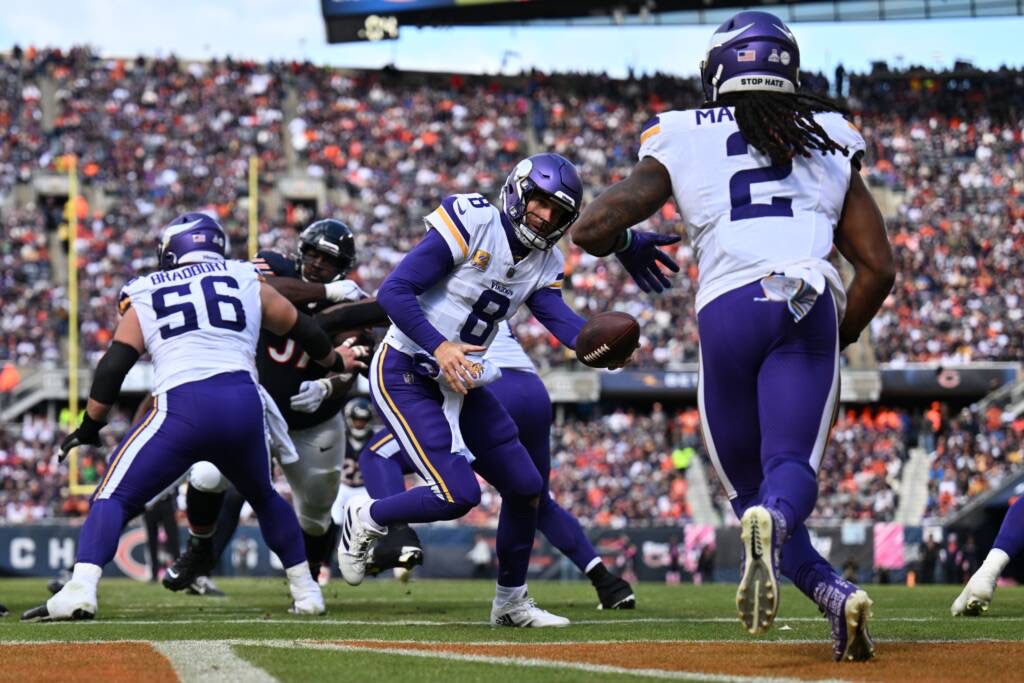
Before we get into the details of the Vikings scheme, let’s go over what exactly the run game in football is. If you want to skip ahead and go right into the Viking-specific breakdown, click here.
There are multiple schemes in football, and the philosophies and personnel requirements do vary based on the scheme. These schemes are:
- Zone – IDs a “zone” or area for the o-line to block, and moves in tandem
- Man – Assigns a specific defender for each o-lineman to block
- Gap – IDs a specific lane or gap, for the o-line to block and open up
Each one of these schemes are typically mixed and matched in any playbook, but there is typically a style that a team prioritizes, as it best matches their offensive personnel.
Zone schemes will usually have more agile o-linemen who have good lateral quickness, as their first step will all go in the same direction. The popular play calls here are “inside” or “outside” zone, with a specific direction called for the line to move in. From there, the running back will be responsible on making a read, whether it’s to follow the o-line, cut back to a hole that formed, or bounce which is to take the run way to the outside.
Man schemes typically require o-linemen that are more powerful. The line gets assigned a specific man to block, and they need to move their defender off the ball to create a hole for the RB. An o-lineman who posses a strong punch and push is strong in this style of scheme, and should be explosive out of their stance to move their defender at will.
Running backs in this scheme typically are bigger backs, that are more powerful. They need to display patience and good vision, as the o-line acts as a wall in front of them, and need to wait for a lane to open.
Gap schemes assign a specific “gap” for the o-line to open up, and the RB to run through. The below graphic highlights the lettering that is used:
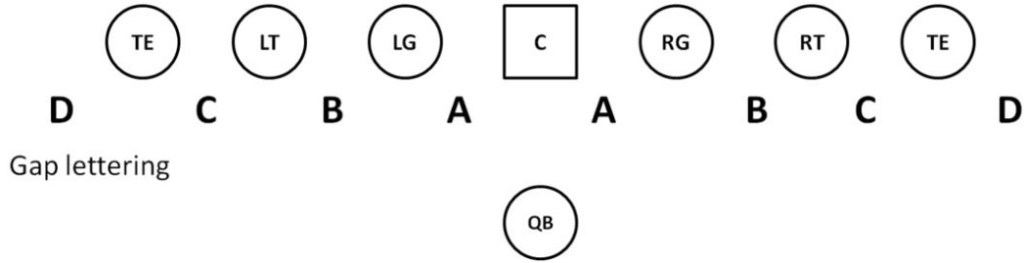
This lettering is often used when discussing defensive lineman and linebacker alignments at the line of scrimmage. Offenses use this lettering, mostly to identify if any defensive player needs to be attacked or double-teamed to accomplish the blocking pattern.
These gaps can be used generally for all run game analysis, especially as you learn and start understanding more about the run game and the specific gaps/holes that are being attacked on any run play.
However, teams will use various numbers and terms to call out which gap/hole is being targeted. You may also hear teams mention running through the “3” hole, for example. Here is a run chart based on the number system:
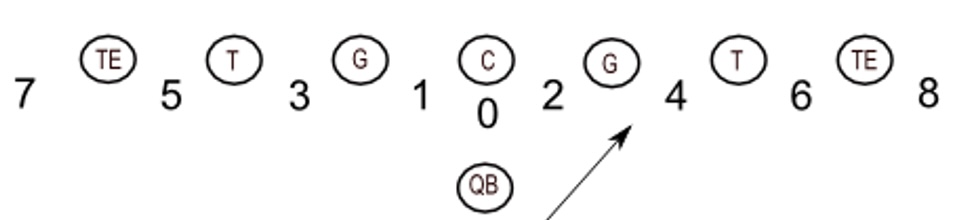
This was the system that I learned through playing and studying the game. I typically use this when describing and drawing plays, and will refer to this method throughout this article.
Lastly, you may hear the QB come to the line of scrimmage and yell “54’s the Mike“, for example. Have you wondered what that meant? This is called ID’ing the Mike, or the middle player of the defense. The Mike can be a linebacker, defensive lineman, or safety, depending on the defensive formation.
ID’ing the Mike is important for all plays, as it will set which way the line will block and attack on run plays. On man run schemes, it will show each o-lineman who their assignment is, as typically the center will be responsible for the getting to the Mike as their primary block.
There’s importance to this for pass blocking as well, and I’ll go into more detail during the Vikings pass game breakdown in next week’s article.
Let’s reference the previous number scheme chart. If a team is running “Duo”, ID’ing the Mike will tell the center and guard who to double team and block to. “Duo”‘ is a common run game play, adopted by the Vikings, that calls for two double teams: double-teaming both interior defensive tackles up to the two inside linebackers, creating a gap for the RB to run through.
Here’s an example of this play in Madden with the Mike ID’ed:
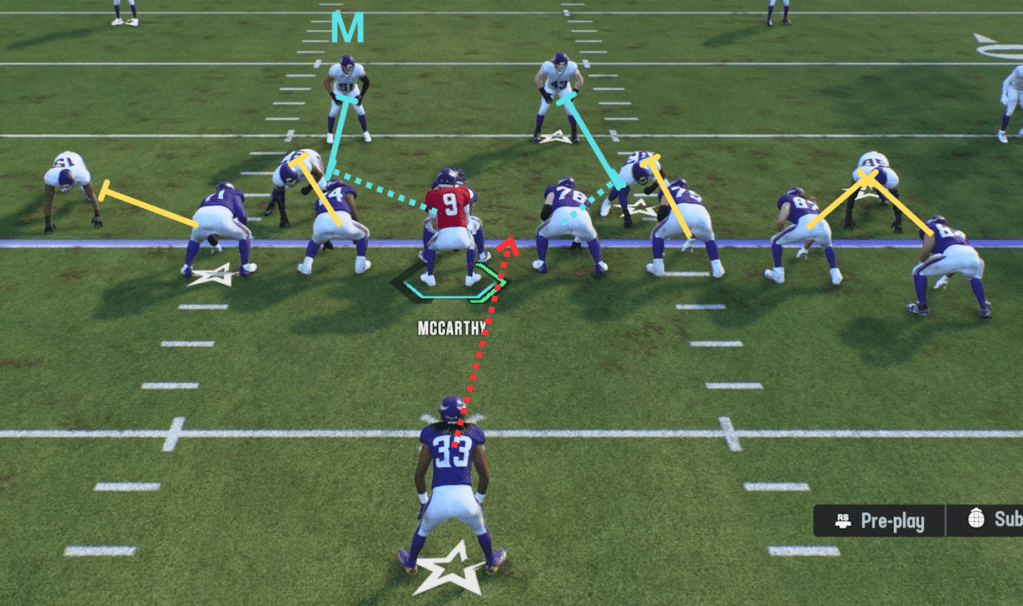
In this play, Blake Cashman (#51) is the Mike, and it is indicating who the center will need to work towards and block. The assignments are:
- LG (#74) & C (#78) will double the left defensive tackle, and work towards the Mike
- RG (#76) & RT (#75) will double the right defensive tackle and work towards the Sam (strong side linebacker)
- LT (#71) is 1:1 with the left EDGE
- TEs (#87 & #84) will double team the right EDGE and “look for work”, meaning they’ll work up field to find the next block, which should be the nickel corner who is cut off on the right side of the image
The RB is going right through the 2 gap, as the interior o-line should work straight up the middle and create a hole in the middle of the defense.
The assignments can vary based on the defensive front, but to keep it simple I set the defense in a basic 4 linemen, 2 linebacker look, a.k.a Nickel base defense.
Now that we have set the groundwork for how a run game looks and operates, let’s break down the Vikings run scheme.
Vikings Run Scheme Breakdown
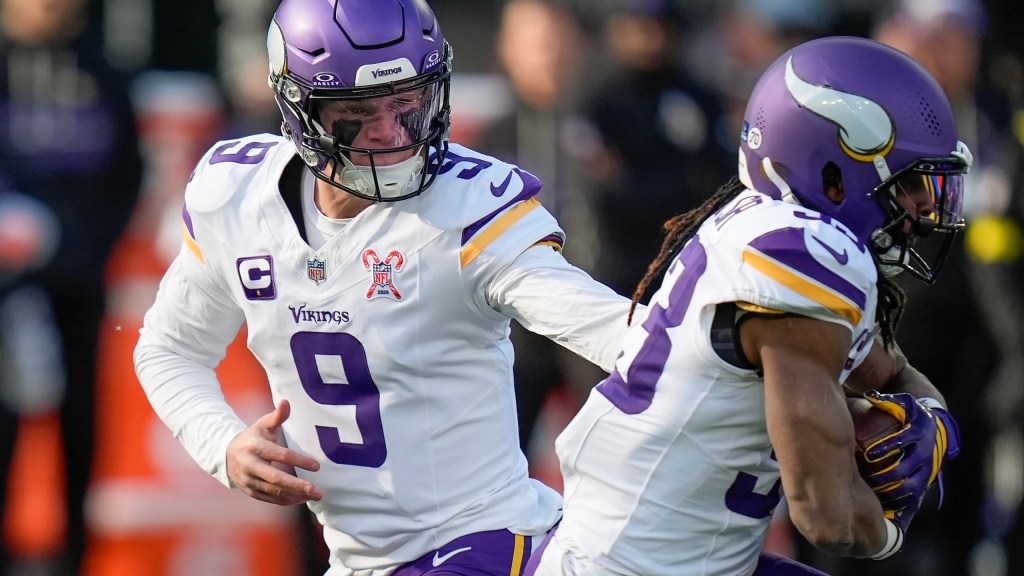
Before we get more into the scheme, let’s quickly highlight the Vikings run game as a unit. Since 2021, their per-game averages are:
- ~24.2 rush attempts
- 2024 being the best season at 26.6 ATG
- 101.1 yards
- 2024 being the best season at 108.7 YPG
Both of these rank in the bottom half of the league since ’21, and the Vikings best finish in attempts per game was 14th in 2024. YPG have been in the bottom half of the league every year as well, with a lot of room for improvement.
Kevin O’Connell believes in a pass-first style of offense, creating field stretching explosive plays. Traditionally, there is a lot of use of play action and run fakes in the McVay & Shanahan system, so why do the Vikings rank so low in their run game metrics?
There are multiple factors at play and fans seem to often get frustrated with the play selection, as it can feel that the run game gets abandoned. The Vikings have played in many one-score games during KOCs tenure, causing the play selection to remain heavy in the passing game. KOC’s play call type trends on the more aggressive side, and there are opportunities to become more conservative, and better establish and maintain the run game.
In addition, the offensive line has struggled and has been an injury carousel. With the run game, chemistry and trust in one another is paramount. With a consistent rotating line, and lack of quality depth, it’s been difficult for the Vikings to find the recipe to create an efficient running offense.
I expect this to be a point of emphasis throughout the off-season again, with hopes everyone can have more luck with injuries this season.
Run Game Strategy
Kevin O’Connell’s run strategy has closely resembled a true West Coast scheme: utilizing a high volume of zone run schemes, with a mix of gap schemes sprinkled in recently. Since 2021, the Vikings have been towards the top of the league in usage of:
- Inside zone
- Outside/wide zone
- Duo, trending up in ’24 & ’25
Other teams that have ranked high in usage for these play types are the 49ers and Seahawks. As a matter of fact, most NFL teams heavily leverage zone run schemes, and this may be something you see and recognize by most teams on Sundays.
Generally, the NFL has about a 65% adoption rate between all teams with the utilization of zone run schemes. The Vikings usage has been above the average, and the focus has primarily been on the use of outside/wide zone. Let’s break down each of these three styles and detail the importance within the KOC system.
Outside/Wide Zone
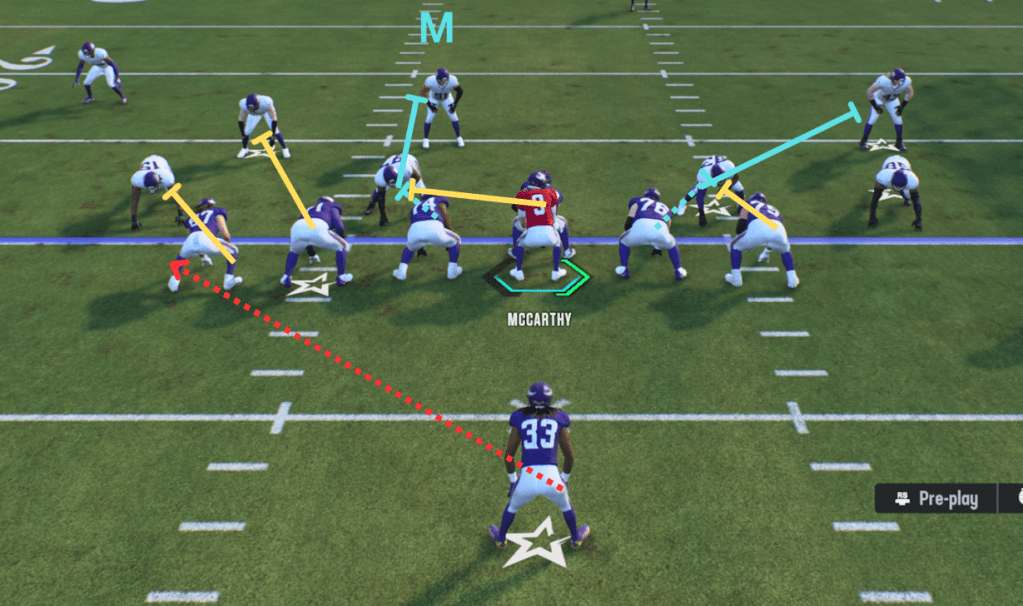
The goal of outside/wide zone schemes is to attack the perimeter of a defense. Just like any West Coast scheme, the idea is to stretch the defense horizontally, forcing linebackers, safeties, and EDGE players to play more sideline-to-sideline, slowing down burst to come downhill. This opens up holes in a defense for passing opportunities, especially off of wide zone play action and bootlegs.
Referencing the number lane system above, outside/wide zone runs target the 5 through 8 lanes, or target runs outside of the tackle or tight end on the line of scrimmage. The offensive line needs to be agile with quick feet as the play side (the direction the run is going) need to be able to reach and stretch the defender that is in their “zone”. It can be a tricky block, especially if a linebacker fires through a gap and beats a lineman to blow up the play.
These play calls can be referred to as:
- Outside zone
- Wide zone
- Stretch
- Sweep
In KOC’s offense, the running back is responsible for “pressing” the correct lane. “Pressing” refers to the running back sticking to the lane, or running towards the hip of a tackle or tight end, forcing the defense to move towards the flow of the run. This is important, as it can create a cut or bounce opportunity, which can result in an explosive run.
You may hear the term “one-cut running back” in this style of scheme, and this mold is the perfect fit for this offense. A one-cut running back is responsible for finding the best seam/lane in a run play, cutting, and exploding through the lane. Aaron Jones and Jordan Mason are two good zone running backs, as they can ID which seam and hit the hole pretty consistently.
Wide zone plays are also used in play calls for jet sweeps. In 2025, Jordan Addison took a jet sweep 65 yards for a TD against the Lions on Christmas day:
The same rules apply for WR sweeps, the o-line all move in the same direction to cover their zone, and have to reach and stretch to make sure the WR can rush to the outside and find an explosive run.
An underrated aspect of this scheme is the necessity for WR blocking. They play a critical part, as they will need to either:
- Chip edge defenders or linebackers
- Block safeties
- Seal off corners
If they do not properly block, then outside runs can get blown up and eliminate any threats in this run scheme.
The likes of Justin Jefferson, Jordan Addison, and Jalen Nailor, are all committed blockers, and play crucial roles on every run play. Nailor was a solid blocker, and would be motioned in between the tackle and tight end to make blocks, too. We’ll discuss this more in the formations and putting it all together portions later in this series.
In close, this run scheme accounts for roughly 37-40% of the Vikings run play selection. They’ve been towards the top of the league in wide/outside adoption during KOC’s tenure, and I expect this to remain true in 2026.
Inside Zone
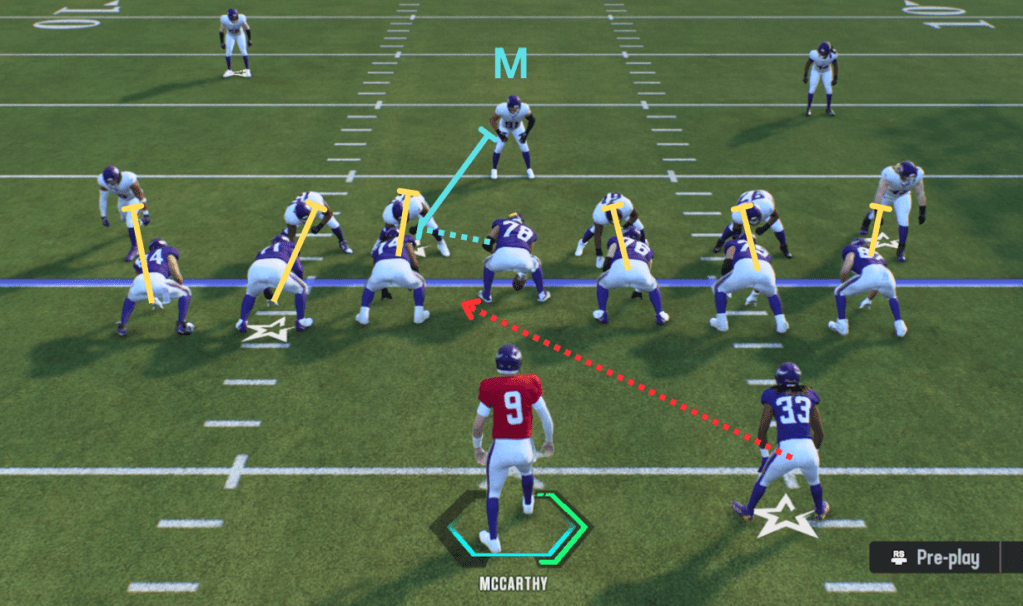
Similar to outside/wide zone, inside zone requires o-linemen to all move in sync to block the defender in their zone. However, the target lanes and defenders are different.
In inside zone, the goal is to attack the 1 through 4 gaps in a defense. There will also traditionally be more double teams, as the linemen need to create a wall and work to the second layer of a defense to create lanes for the RB.
The “Mike” defender is critical to ID in inside zone plays, as the RB typically makes their read based on their movement. If the Mike crashes into the hole, then a cutback opportunity opens. If he is aggressive and tries to beat the blocker outside, then the RB can cut up the field and be into the final layer of a defense.
Inside zone blocking also uses “covered” or “uncovered” lingo for the o-lineman to determine their block. If an o-lineman’s zone is “covered” then he is responsible for blocking that man and kicking him out.
If an o-lineman’s zone is “uncovered” then he will typically help double team in the direction of the run call, and look to get to the second level, typically to an inside linebacker.
Inside zone can sometimes be confused for duo style runs. We’ll talk about duo in the next section, but these run styles can look similar. The key difference is inside zone will be more lateral, looking to open up multiple lanes for a RB to read and cut off of.
Here’s an example of the Vikings in ’24 running inside zone, that has two double teams. This play runs more lateral, as all the lineman step in the same direction, with the fullback inserting to block the Mike:
Inside zone is also commonly used for option plays. With Kyler Murray joining the team, it’s highly likely that KOC will adopt more QB read options and RPOs. The use of inside zone is important with these run types, as the lineman will block laterally, but leave a defender unblocked, which is the “read” player.
If a QB option is tagged, then traditionally the read defender is the EDGE, and if he crashes, then the QB can keep the ball and rush outside. The goal is for the rest of the defense to flow towards the run side, working as a curated “bounce” run by the QB.
RPOs have become quite the buzzword in the NFL in recent seasons. They originated more in the collegiate level, but have been adopted by the NFL. The problem is, announcers refer to plays as RPOs for almost all option plays, which I’ve seen cause a lot of confusion on what an RPO actually is.
RPOs are “run-pass options”, which like a read option, will highlight a defender as the read, leaving them unblocked and using their movement to decide which option to take. This includes linebackers, safeties, and nickel corners, with the goal of hitting a pass play in the area of the field they void to fit the run.
In KOCs offense, you’ll see this with quick posts/slants, or vertical routes up the seams (AKA the area between the hash marks and numbers on the field). Inside zone is a critical part of these plays, as the goal is to force the defense to cheat up, opening up a quick pass right behind them before they can react. This also gives a numbers advantage to the offense, allowing more blockers in front of the run play option.
Just like the adoption of wide/outside zone runs, the Vikings are towards the top of the league in adoption of inside zone, too. In recent season, the Vikings have ran inside zone on 35%+ of their run plays. Expect this to remain high, even with the new threat that can be created if Kyler wins the job.
Duo
Duo has become more prominent in the Vikings game plans the last couple of seasons and especially with the o-line remodel last off-season. With Donovan Jackson and Will Fries at the guard spots, the offensive line has gained a tougher, nasty streak, allowing the line to fire and be more physical with their blocks.
Kevin O’Connell has mentioned the importance of using more gap schemes, and it’s not too entirely different from the zone schemes we covered previously. The major difference in duo/gap schemes is the goal is to get vertical.
The o-line will each get a gap assigned to them, depending on the run play side direction. From there, instead of the line working laterally, they are responsible for getting vertical and creating gaps for a RB to read and run through.
The important part of duo, and where the name originated from, is the use of multiple double teams across the offensive front. The double teams work on attacking defensive lineman who threaten the run gap, and working up to the second level of the defense.
Duo is traditionally ran through the 0 through 4 holes, as the RB needs to run downhill through the lane the o-line is creating. The RBs responsibility does mirror zone scheme runs, as they need to read and react based on the gap the LBs are filling.
If a LB stays wide, then the RB will run through the middle of the defense. If a LB fires and fills the middle, then the RB can cut and go through the 3/4 hole (depending on the play side) for a positive gain.
Duo doesn’t typically generate many explosive runs, as there isn’t typically a lot of opportunity for runs to bounce. The goal is to get vertical, and depending on the defensive alignment, the safeties will be filling the gaps that may have been missed by the first and second layer of the defenses, causing a lot of traffic for a RB to sort through.
However, these schemes are great for low-redzone (inside the 10 yard line) opportunities, as the defense is compressed and easier to double team and block vertically.
Play action can also be a big advantage here, as teams can double team the most dangerous pass rushers, with the goal of getting the LBs downhill and hitting a crossing route or dig (in route) behind them. We’ll go into more detail on this in the passing breakdowns over the next two weeks.
We’ve seen an increase in the use of duo across the NFL, and teams including the Rams, Ravens, and Eagles have been towards the top of adoption over the past few seasons. The Vikings usage of duo is lower in comparison to the league average. One of the Vikings tendencies was the use of duo with heavier personnel, primarily using 22 & 13 personnel. However, I wouldn’t be shocked to see KOC continue the trend of more adoption of duo, especially earlier in games to establish the run and get the o-line going.
The Arizona Cardinals were a team with higher usage of duo under Drew Petzing, with the use of James Connor. Kyler Murray has an understanding of this scheme, and brings the element of QB read options.
Additionally, Frank Smith brings in more experience with the balance of zone and gap schemes, further validating KOCs mandate for adopting more gap scheme runs. As the Vikings run game evolves, I expect the use of duo/gap scheme runs to grow under Smith’s tutelage, and be less personnel dependent moving forward.
Final Thoughts
While the Vikings primarily use the above run schemes week-to-week, they also adopt other run plays to keep defenses honest and off-guard with a new tendency from time-to-time. These plays may include:
- Counter
- Toss
- Draw
- Power
- Iso
Kevin O’Connell has expressed the desire to adopt more gap-scheme run plays, and the Vikings used more duo, and sprinkled in other tendency breakers in ’25. I expect this to continue trending upwards, especially with the way the offensive line is built, and how KOC wants to manipulate the defense to open the pass game.
The best offenses are the teams that can make every play look the “same”, causing the defense to slow down their thinking and be more reactive than proactive on any given snap. KOC has said this multiple times, and the run game is the bedrock of his scheme. If the Vikings offense is to take a leap next year, then elevating the run game will be the number one reason.
Everything KOC wants to do in the pass game relies on a honest and efficient run game. Come back next week as we start the first of two passing game breakdowns, and how KOC wants to attack defenses.
Thank you for taking the time to read my latest article! If you enjoyed the read, please support the blog by liking and commenting below. Sharing with your friends and family would go a long way as we continue to build this community. And as always, SKOL!

 Skol To Go
Share your thoughts